
Lord Nadarajar
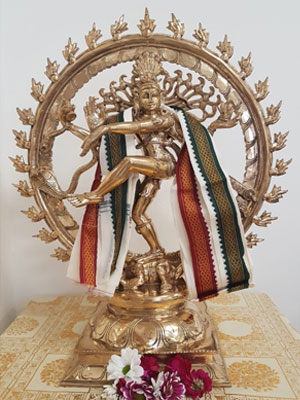
The great Hindu God Shiva has many guises and representations but perhaps the most familiar one is the divine dancing figure within a circle of fire, Nadarajar - the Lord of Dance.
In this remarkably standardised form evolved under the rule of the Cholas, the God is shown dancing within a flaming halo ( Prabhamandala) which symbolises the Hindu conception of the never ending cycle of time.
The purpose of this divine dance ( Thandavam) is to release men from illusion of the idea of the “self” and of the physical world. It’s believed that cosmic dance was performed in Chithambaram in South India called the centre of the universe by Hindus.
The gestures of the Thandavam represent Lord Shiva’s five activities: Creation symbolised by the damaru holds in upper right hand , protection - abhayamudra ( the gesture that allays fear) by lower right hand, destruction - by Agni holds on his upper left hand, embodiment ( apasmarapurusha- illusion which leads mankind astray) - represented by the dwarf like figure being tampered by his right foot, and release - Shiva’s front left hand, pointing to his raised left foot, signifies refuge for the troubled soul. The energy and wildness of the dance shown by extravagant spreading of God’s hair.